|


United States : Minnesota
4.9 miles (7.9 km) N of East Grand Forks, Polk, MN, USA
Approx. altitude: 246 m
(807 ft)
([?] maps: Google MapQuest OpenStreetMap topo aerial ConfluenceNavigator)
Antipode: 48°S 83°E
Accuracy: 22 m (72 ft)
Quality:
Click on any of the images for the full-sized picture.
| 48°N 97°W (visit #3) |
![Visit #2: [25-May-24]](/us/mn/n48w097v2/preview.jpg "Visit #2: [25-May-24]")
![Visit #1: [22-Dec-00]](/us/mn/n48w097/preview.jpg "Visit #1: [22-Dec-00]")
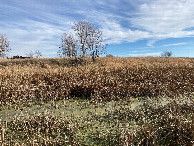
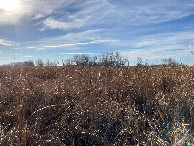
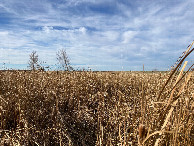
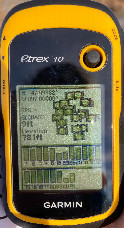
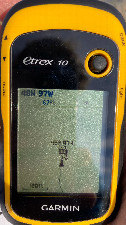
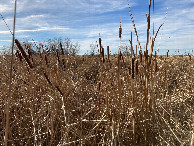
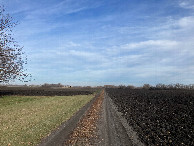
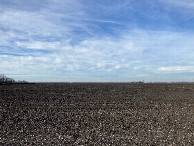
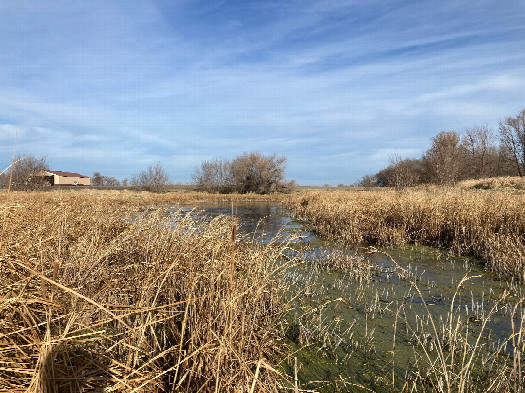 (visited by Michael G) 14-Nov-2025 -- In Grand Forks with a few hours to spare — on an anomalously nice November day, at that — I saw no reason to pass up a visit to the local confluence, about 10 miles [6 km] northeast of town. Despite 48N 97W landing smack in the middle of the Red River Valley, a very featureless and homogeneous domain (with regard to terrain and land use, respectively), this confluence looked like it'd provide a relatively interesting hunt (by the standards of the Upper Midwest). There were two reasons for this: (1) it's in the middle of a creek, making a zero-meter visit highly unlikely without a raft or risky wintertime walk on the ice, and (2) the point's proximity to nearby farm buildings and homes would necessitate a brief chat with a landowner (or so I had thought). From town, it didn't take long to reach my initial destination: a cluster of farm buildings that stand only about 200 meters northwest of 48N 97W, where I planned to park. I headed north out of East Grand Forks at about 9:45 AM and was there by 10, not a single turn required (except into the driveway). Upon arriving at the end of said driveway — already just a tantalizing 150 meters away — I realized that my western approach plan wouldn't work. None of the buildings here looked like homes, the place was desserted, and I was greeted by a "24 Hour Surveillence" sign. I could see the confluence's creek (the Grand Marais Creek) from there, but was not about to get out of my car and walk directly toward the landowner's tractors that stood in the way. (That was probably about the most suspicious thing one could do in that situation.) It was time for Plan B, the approach used by Joseph Kerski in his springtime visit last year. I flipped a U-turn and headed back to the highway, onto which I'd make my third turn since leaving East Grand Forks. A few moments later I parked my car almost exactly on the 97th meridian, on the side of County Road 65 — there was a home here, and a dirt track that led north to the confluence. Because the track lies directly beside said home, I decided it would be best to see if anyone was there before proceeding. I waited a couple of minutes on the front steps but there was no answer at the door, surprisingly (two vehicles were in the driveway): for better or worse, nobody was around this morning. Seeing no "private road" signs, I decided to change into boots and start walking north along the path — about a half-mile [800 meters] between me and the 48th parallel. The fields on either side of the path were empty, likely harvested a month or two before. In every direction I looked, the horizon was flat and absent of truly distinguishing features (see photo)... the quintessence of northeast North Dakota/northwest Minnesota. I could see cars on the state highway about a mile west and a corridor of trees to my north and east, lining the Grand Marais Creek. In this obstacle-free environment and with a southerly breeze at my back, I reached said trees along the wetland's edge only a few minutes after leaving the car. I'd now split from the dirt track, having continued due north almost to a fault — with 200 meters (about 1/8 mile) still between my location and 48N 97W, I descended into the marshy, reed-covered wetland along the creek's edge. In retrospect, starting the marshy bushwhack 200 meters away was a questionable move. Although I kept on a northward trajectory, the confluence was now to my north-northwest (unbeknownst to me) — I was accidentally taking an approach that maximized my time in less-than-ideal walking terrain. From here on, crispy, six-foot tall reeds and cattails abounded and hid the surface on which I was walking. I slowly but forcefully lunged my way ahead, taking care to remain away from the "actual" creek, which appeared to be a dozen meters east of me. Pushing through the reeds proved to be a tedious task, their density high enough that I could sometimes walk atop a crushed (and unstable) bed of them. After a few minutes, I reached the 100-meter successful visit range and paused to reorient myself, at [47.99924, -96.99964]. Here, I noticed a gap in the reeds that revealed the ground — a pale green that resembled algae or a minigolf course's turf. I pressed my boot harder and a piece of it gave way to water: I'd inadvertantly wandered my way onto the creek's surface, in 50°F [10°C] temperatures, mind you. It admittedly took some restraint to move methodically westward toward safer ground (instead of rushing in panic)... ice was the last place I wanted to be standing on a day like this. Upon reaching sturdier ground, the GPS indicated I was directly south of the confluence, about 70 meters away — I could now proceed north for as long as I wasn't at risk of an involuntary polar plunge. Lunging further through the dormant wetland atop a seemingly stable surface, it was exciting seeing the latitude tick higher towards 48°N. Part of me even thought I'd have a shot at reaching the exact spot! In reality, I arrived at a very obvious stopping point about 20 meters short of the confluence point, where reeds and cattails gave way to ice. I took care to zero out the longitude and called it a victory — I could now see 48N 97W just north of me, at an unfrozen point on the creek! This marked my second Minnesota confluence and sixth visit to 97°W. Being in the middle of the wetland, the views from this spot mostly consisted of reeds, trees, and water/ice. A few farm buildings (that I'd earlier rejected as a starting point) were visible to my northwest, the only exceptions. While gathering the directional photos, I reflected on the seasonality of the spot, having achieved its first autumn visit. Dormant vegetation and drier conditions must make October and early November the easiest time of year to complete this confluence, well after summer rains (and mosquitos), but before heavy snow and intense cold sets in. A November 14th visit very well could have been cold; today's weather was highly unusual. It was mid-morning and the temperature had already warmed to about 50°F [10°C], helped by a steady southerly breeze and partly sunny skies. (It would reach 65°F [18°C] that afternoon at the regional airport, easily setting a record high for the date.) Having gathered the requisite photos and sufficiently appreciated the absurdity of my surroundings (it was not a place you'd expect to find a person wandering), I started back to the car. Now properly oriented, I proceeded southwestward on the shortest route out of the wetland and back to the farm path. I reached my vehicle about 30 minutes after first leaving it, feeling very pleased with my excursion and grateful to have avoided the Grand Marais's icy November grip. An ideal way to kick off my short visit to Grand Forks! |
| All pictures |
| #1: Looking north at 48N 97W from my closest approach, located about 20 meters away #2: Looking east from my closest approach, at a frozen part of the creek #3: Looking south #4: Looking west #5: Zeroes on the longitude! #6: About 70 feet away #7: Most ideal walking area #8: Looking north on the farm path, about 600 meters south of 48N 97W #9: A typical view for the region, looking west on the path ALL: All pictures on one page |
| Notes |
|
In the middle of Grand Marais Creek. |