|


China : Yúnnán Shěng
6.9 km (4.3 miles) WNW of Geyitou, Yunnan, China
Approx. altitude: 2072 m
(6797 ft)
([?] maps: Google MapQuest OpenStreetMap ConfluenceNavigator)
Antipode: 26°S 76°W
Accuracy: 5 m (16 ft)
Quality: good
Click on any of the images for the full-sized picture.
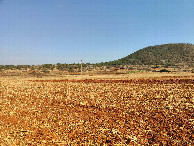
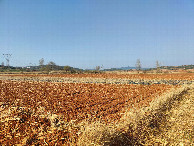
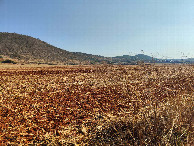
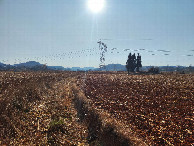
| 26°N 104°E |
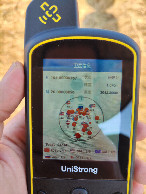
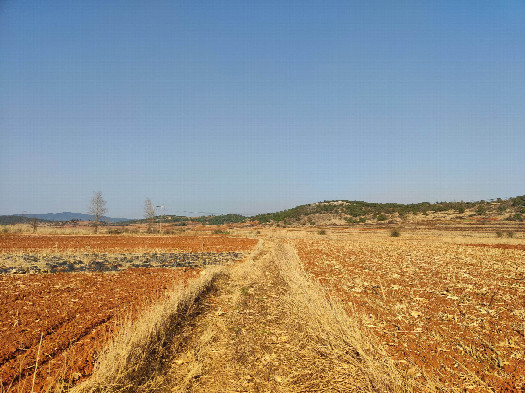 (visited by Xinhao Cheng and Jing Cheng) 18-Feb-2026 -- Following the Dust of Deep Time: From 25°N to 26°N (Continued from 25°N 104°E) Leaving 25°N 104°E, we retraced our path down the winding mountain road, continuing eastward through the canyon before veering north a few kilometers later. The undulating mountains were soon left in our wake. As we merged onto the north-south expressway, we found ourselves traversing the quintessential landscape of the ancient peneplain. Surrounding us were rolling, low-slung hills of red earth, their rise and fall so gentle they were almost imperceptible. Villages and farmlands were scattered throughout, interspersed with fragmented thickets and fallow plots, creating a vast, mosaic-like vista. It was early spring; the dry season wind blew fierce and parched across this deep crimson earth bathed in sunlight. In the glare of the midday sun, the scenery appeared stable and balanced, with nothing protruding from the whole. Upon closer inspection, however, the details emerged: peach and pear blossoms were in bloom, and willows had begun to sprout tender green buds. In some fields, wild peas and other unfamiliar flora were in flower, while most plots remained unplanted, reflecting only a steady, clamorous red. The violent geological events of Deep Time have been washed away by successive highland springs, leaving behind only the most serene and mundane of surfaces. Eventually, undulations reappeared on the horizon as we suddenly entered a tunnel several kilometers long. When we emerged from the other end, the Qujing Basin lay spread out beneath our feet. The road stretched northward along the eastern edge of the basin. To our left, the Nanpan River appeared intermittently, wandering southward. At this point, so close to its source, it was far from the mighty torrent it would become as the Pearl River downstream. Soon, we crested a cluster of hills and re-entered the expansive peneplain. The road unspooled across the red earth, dotted with occasional limestone "mound hills." We finally stopped at the village nearest to our target intersection. Its name: Shitoudi—"The Stony Ground." The virtual trajectory leading to the confluence pointed northeast. I followed this path through the village and out into the vast farmland. Here, a subtle misalignment occurred between the abstract texture of latitude and longitude and the physical texture of the earth. Following my navigation, I first passed under north-south high-voltage power lines, then stepped through a field of wild peas. The chirping of crickets abruptly ceased at my approach, only to timidly resume once I had passed. I then had to cross several fields of red soil that had been freshly plowed but not yet sown. These remnants of ancient basalt had become soft and powdery under the relentless dry-season sun, a stark contrast to the sticky, viscous mud they become in the rainy season. As I stepped into the soil, small clouds of dust billowed up, scattering in the wind. Fine grains of red earth inevitably found their way into my shoes—a tactile reminder of the earth’s friction and my own physical presence. The distance closed. Finally, the satellite signal led me onto a dirt track cutting through the fields. The decimals of the coordinates hit five zeros. I laughed in spite of myself. Suddenly, a violent gust of wind swept past. My hat flew off, landing in a neighboring field and startling two magpies hidden there. They took flight against the wind, hovering for a dozen meters before settling back down into the red earth. |
| All pictures |
| #1: the general area #2: east view #3: north view #4: south view #5: west view #6: GPS view ALL: All pictures on one page |