|


United States : North Dakota
2.5 miles (4.1 km) SW of Plaza, Mountrail, ND, USA
Approx. altitude: 626 m
(2053 ft)
([?] maps: Google MapQuest OpenStreetMap topo aerial ConfluenceNavigator)
Antipode: 48°S 78°E
Accuracy: 3 m (9 ft)
Quality:
Click on any of the images for the full-sized picture.
| 48°N 102°W (visit #4) |
![Visit #3: [26-May-24]](/us/nd/n48w102v3/preview.jpg "Visit #3: [26-May-24]")
![Visit #2: [25-Sep-05]](/us/nd/n48w102v2/preview.jpg "Visit #2: [25-Sep-05]")
![Visit #1: [17-Jun-01]](/us/nd/n48w102/preview.jpg "Visit #1: [17-Jun-01]")
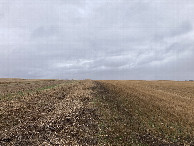
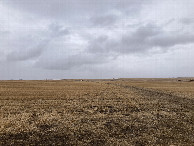
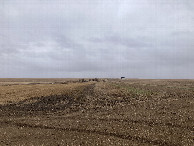
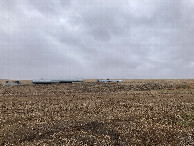
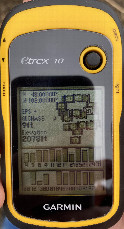
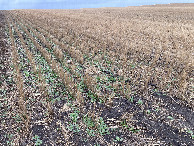
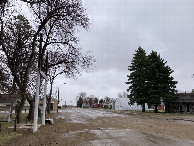
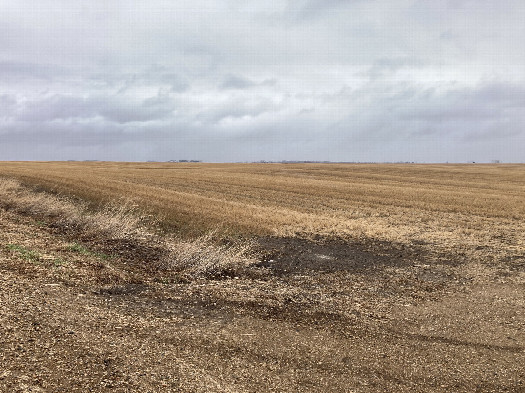 (visited by Michael G) 23-Apr-2026 -- Having done minimal exploration since last month and feeling a little stir-crazy as a result, I hit the road for a day trip to visit a new county and confluence — a surefire way to ease the springtime restlessness. Today's targets were Mountrail County and 48N 102W, North Dakota's complimentary roadside confluence point, likely the state's easiest to visit. Much like 46N 100W and 45N 100W to the southeast, this confluence occurs beside one of countless gravel grid roads that girdle the largely cultivated expanses of the western Missouri Coteau. Driving north on US 83, my car was buffeted by strong westerly winds; for the sake of a more interesting visit, I'd chosen an afternoon during which a strong extratropical cyclone was centered a few degrees latitude north of my goal (between 50°N and 51°N, on the Saskatchewan/Manitoba border). I thus enjoyed a lively and fast-changing sky on the road to the 48th parallel, a broken overcast of puffy clouds floating eastward and occasionally offering brief peeks of sun. The surrounding landscape was showing early signs of spring — while almost all the cropland that I saw remained unplanted and lifeless, patchy shades of green had started to emerge on plots of grazing land. This signaled the eventual and inevitable end of Father Winter's annual reign in the Northern Plains, though his weakening influence was undoubtedly present today. My car's thermometer reading had gradually dropped over the course of the afternoon and soon began a steeper decline after turning west onto ND 23, a state highway that closely parallels 48°N. Thicker and lower clouds loomed in the direction I was traveling and all glimpses of the clear sky soon disappeared. These clouds eventually yielded a misty mix of light rain, snow, and tiny ice pellets, as the temperature had fallen to around 35°F [2°C]. The fine mix of droplets and flakes efficiently clouded my windshield and turned the subtly rolling landscape dreary and dull; as a California native, I could hardly believe that this constituted a late April day. I spotted the Mountrail County sign between sweeps of the windshield wipers and several miles later reached 66th Ave NW, the drivable incarnation of the 102nd meridian. 66th Ave NW was a gravel road signed as being "minimum maintenance", but thankfully in fine shape for my purposes (especially when compared to the muddy farm paths it intersected). The confluence is about a mile-and-a-half [2.5 km] north of the highway, during the course of which I passed a well-kept farmhome and a few dips and ridges in the otherwise mundane terrain. The west side of the road was lined with unconstructed metal power poles and their concrete bases (see photo), spaced at regular intervals — an ongoing project, evidently. I parked 150 meters north of one of these presently powerless poles that happened to lie on 48°N, next to the confluence point. The air's sharp chill was immediately noticeable once I left the car, and I felt pin-pricks of ice pellets against my face with each gust of wind. The adjacent field was covered in yellow-brown stubble, growing season still a few weeks away (overnight freezes finally become less frequent in early to mid-May). I quickly reached the 48th parallel and shuffled a few paces east of the road's shoulder, watching the GPS coordinates tick closer to my target. A few moments later, the display showed all-zeroes — I now stood at 48N 102W, my third successful North Dakota confluence and second visit along 48°N! The confluence was a quiet and nearly lifeless spot this afternoon, some hardy young weeds and grass adding a slight green accent to the otherwise dormant landscape. On the northeast horizon, a cluster of trees and buildings marked the nearby town of Plaza. Low clouds overhead continued to race from west to east with the persistent breeze (which for its part, had produced a wind chill temperature of 22°F/-5°C). This area is no stranger to exceptional cold; 48N 102W has the distinction of being just 7 miles [11 km] northeast of Parshall, the site of North Dakota's all-time record low: -60°F [-51°C], recorded in February 1936. Satisfied with my observations and also thoroughly chilled, I started back to the car. The not-too-distant trees of Plaza beckoned — shortly thereafter I set off a couple of miles north and east to explore 48N 102W's nearest population center and to look for lunch. The town was particularly quiet on this brisk late April day, Main Street more or less deserted. Just west of Plaza's plaza, I noticed the only nearby parked cars in front of an unassuming building with blue metal siding — the town's cafe, as it happened! This spot (the Ahava Shack) served an excellent burger and fries; of the numerous reasons to enjoy confluence hunting, finding out-of-the-way restaurants is one of my favorites. I left the town and departed the confluence area south via Parshall, continuing on to the wide-open landscapes along the north side of Lake Sakakawea. |
| All pictures |
| #1: Looking northeast at 48N 102W, located in the middle foreground beside the patch of bare dirt #2: Looking north from the confluence #3: Looking east #4: Looking south, towards a nearby home #5: Looking west, at an unconstructed power pole #6: Zeroes on the GPS! #7: Weeds near the confluence point #8: Looking east from Plaza's plaza ALL: All pictures on one page |